TALUS
Autonomous Humanoid Robotics Platform
A multidisciplinary humanoid robotics project integrating electronics, embedded control, mechanical systems, and intelligent software.
Technologies
Overview
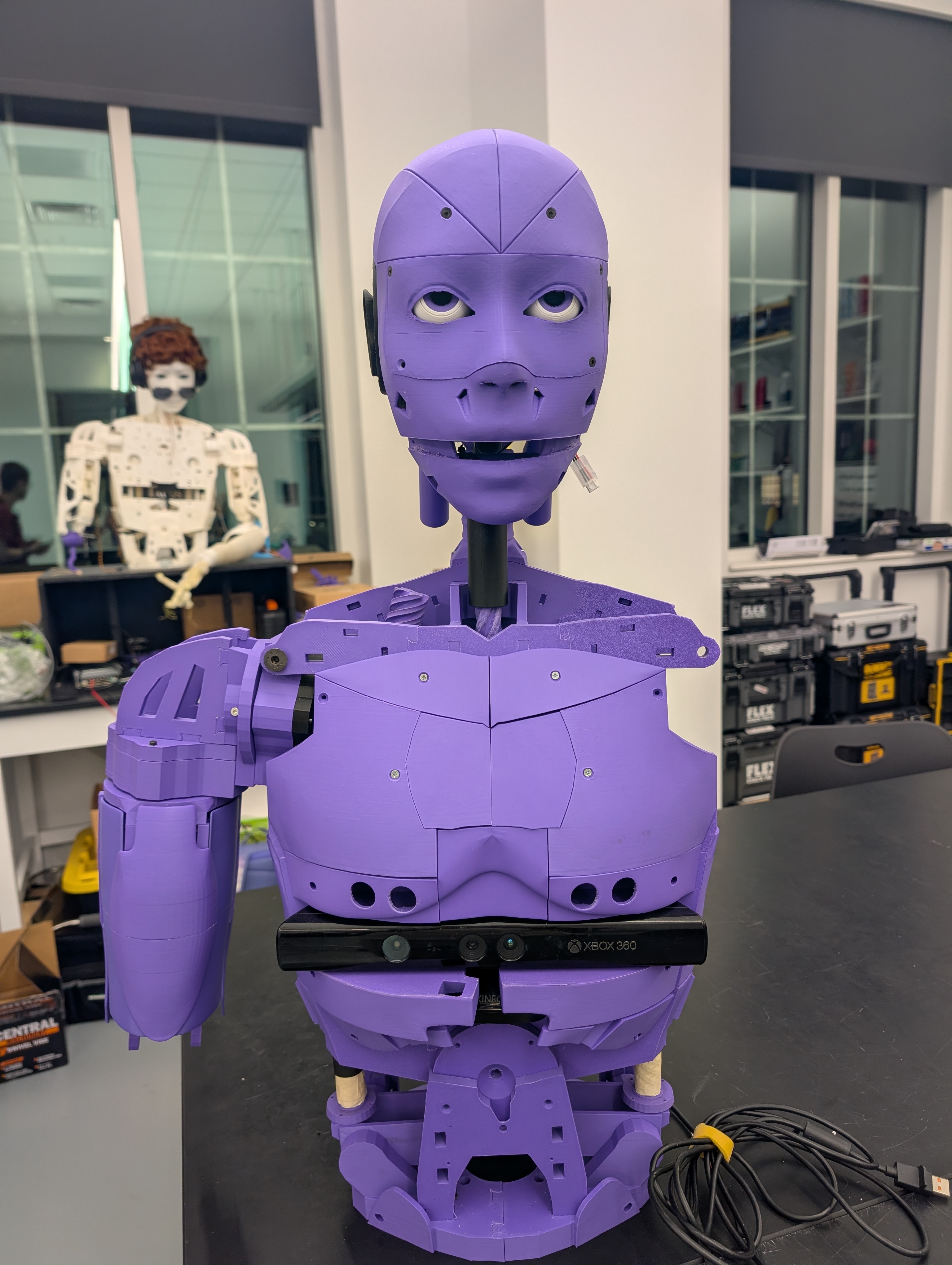
TALUS began as an Autonomous Robotics Club (ARC) project in 2010. The club started a second version one semester before I joined, and that is the version I am now helping develop. Our goal is a humanoid campus assistant that can interact naturally with students and visitors.
I have focused primarily on software and a custom modular control architecture, working from the project goals discussed with the current project lead. Along the way, I have gained experience with PCB design and manufacturing, embedded systems, and computer vision.
My control-system code and documentation are available in the TALUS Control System repository.
My contributions
I designed a distributed control architecture so individual limb modules can be added, serviced, or replaced without redesigning the central control system. Hot-swappable modules are a design goal, which has led me to research inrush control, communication watchdogs, and hardware-disable circuitry.
I also integrated a local AI and speech pipeline with speech-to-text (STT) and text-to-speech (TTS). Supporting multilingual interaction was more challenging than I expected, but it produced an interesting result.
TALUS is intended to answer questions about Tennessee Tech without requiring an internet connection during operation. To support this, I developed scripts that collect public campus information and organize it into a local knowledge database the assistant can reference.
I have also adapted techniques from previous computer-vision experiments to support perception and scene awareness.
- Distributed electronics and CAN-based control architecture
- Custom control-board design and embedded software integration
- Local AI, speech, and campus-knowledge software
- Computer vision and mechanical modeling/simulation
Engineering challenges
Space inside the robot chassis limits where electronics can be placed and which processors can fit. Those constraints affect the computing resources available for AI, speech, and computer vision, so packaging and workload allocation have been recurring design tradeoffs.
Another major challenge is controlling a large number of servos safely and consistently. Rather than using an ad hoc wiring solution, I developed a custom distributed motor-control architecture. The design has gone through several iterations as I learned more about PCB layout, power distribution, and module safety. Integration and validation are ongoing.